

Shared Parental Leave was introduced a decade ago to encourage greater paternal involvement in childcare. However, the scheme is facing increasing criticism for failing to meet its intended goals.
Despite its aim of allowing parents to share leave and pay after the birth or adoption of a child, analysis reveals that the scheme suffers from a significant awareness gap between high and low earners, as many parents remain uninformed about the option.
What is Shared Parental Leave?
To understand Shared Parental Leave (SP leave) and Shared Parental Pay (SP Pay), it is first necessary to understand that mothers are entitled to:
- Up to 52 weeks of statutory maternity leave.
- Up to 39 weeks of statutory maternity pay.
SP Leave/Pay allows parents to transfer a proportion of the mother’s entitlement to the father.*
As the first 2 weeks of maternity leave are compulsory for the birth mother, eligible parents can transfer up to 50 weeks of leave and up to 37 weeks of pay from the mother to the father.
The aim of the scheme is to offer greater flexibility enabling both parents to be actively involved in childcare. SP Leave can be taken in various ways:
- Together: Both parents can take SP Leave at the same time.
- Separately: Parents can take SP Leave at different times.
- In blocks: SP Leave can be taken in multiple blocks of leave.
Eligibility for Shared Parental Leave:
SP Leave/Pay is available for parents who are:
- having a baby
- using a surrogate to have a baby
- adopting a child
- fostering a child with plans to adopt
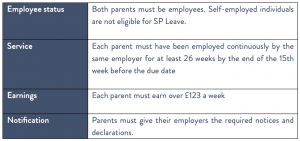
To be eligible, both parents must meet certain criteria:
How to Apply for Shared Parental Leave and Pay:
Applying for SP Leave and SP Pay involves several steps:
- Curtailment Notice: The mother (or primary adopter) must give at least 8 weeks’ notice that she intends to curtail her maternity (or adoption) leave and pay.
- Entitlement and Intention Notice: The partner taking SP Leave must give their employer written notice that they are entitled to SP Leave, and how much they intend to take.
- Booking Notice: The partner taking SP Leave needs to give their employer at least 8 weeks’ notice of the SP Leave they will take.
There are a number of useful templates for these documents available on the ACAS website: Shared parental leave forms and templates for parents | Acas
Key Considerations:
- There are specific notice periods that must be adhered to when requesting SP Leave and SP Pay. Failure to provide the required notice can result in the request being denied.
- Employers must consider requests for SP Leave and SP Pay fairly. However, they can refuse a request if it would cause undue disruption to the business.
- SP Leave can be combined with other types of leave, such as maternity leave or paternity leave, but certain rules apply.
- Some employers offer enhanced SP Leave or SP Pay that is more generous than the statutory entitlement. It is worth checking your employment contract or company policy.
- Paternity Leave and Unpaid Parental Leave is targeted for reform under the Employment Rights Bill
Conclusion:
Although SP Leave and SP Pay has been subject to mounting criticism, the schemes can still provide a valuable opportunity for parents to share childcare responsibilities.
If you are an employee in need of advice on your rights regarding the SP Leave or Shared SP Pay scheme or you are an employer seeking advice on employee rights, please get in touch: rmcculloch@bussmurton.co.uk
*For the sake of simplicity and clarity, this article uses the terms “mother” and “father” to differentiate between parents. The term “mother” is intended to include adoptive mothers, birth parents, primary care givers. The term “father” is intended to include spouses, partners or civil partners, including same sex partners.
For bespoke advice on this or any other area of law, get in touch with the team now.
Meet the wider team